Please update your Flash Player to view content.

About your Putnam Land Conservancy

"Conserving Land and Water for People and Wildlife"

Putnam Land Conservancy places over 2,400 acres into conservation in 2011

The Florida Communities Trust (FCT) program awarded the Putnam Land Conservancy (PLC) $8.3 Million in grant funding to purchase 2,400+ acres in Putnam and Alachua counties during 2010. Private donors contributed over $600,000 to place five large properties into public ownership. Three landowners placed or added to conservation easements on environmentally sensitive lands protecting the area watershed. These conservationists joined 240 PLC members in conserving land and water for people and wildlife in and around Putnam County, Florida.

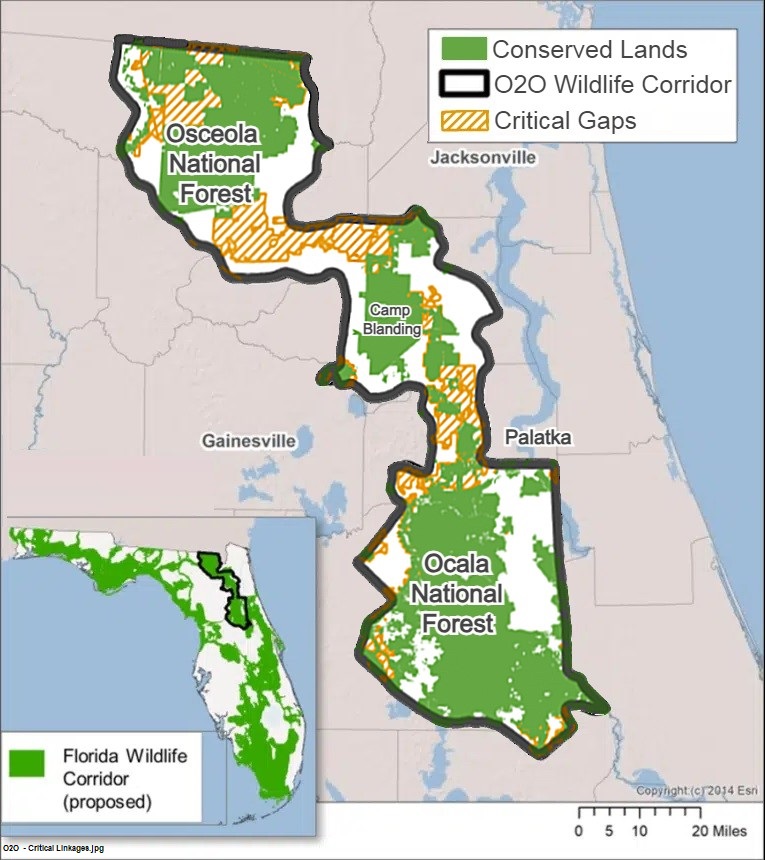
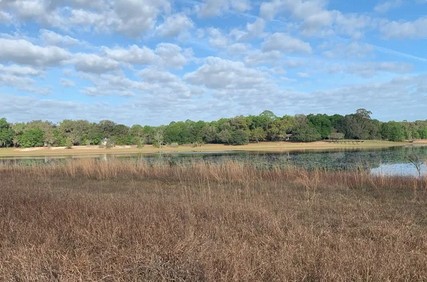
A FCT land acquisition grant purchased the Nine-Mile Swamp property extending from SR 20 to SR 100 and placed into public ownership extensive wetlands that are a much-used black bear corridor. The property’s eastern boundary directly abuts Rice Creek Conservation Area, a 5,061 acre natural area managed by the St. Johns River Water Management District.  To the southeast, it directly connects with the Marjorie Harris Carr Cross Florida Greenway. To the south of the property are the Caravelle Ranch Wildlife Management Area and the Ocala National Forest.  Collectively, this represents more than 500,000 acres of contiguous public lands. The property will be open for public recreation in 2012, providing fishing, picnicking, and primitive camping at Rainbow Lake. There will be some habitat restoration.  A private owner has recently purchased an adjoining 3,000+ acres that will be managed for conservation. This area will continue to be a strategic green corridor through Putnam County.

A second FCT land acquisition grant purchased the Little Orange Creek Nature Park located adjacent to the city limits of Hawthorne. The acquisition extends north and south of SR 20 and straddles the boundaries of both Putnam and Alachua counties. The parkland includes over 700 acres of surface water protection along Little Orange Creek as it meanders through Fowler’s Prairie. The park contains a rare pitcher plant bog that borders State Road 20. The area is home to many Florida native plants and animals and is used by the Florida black bear as it travels from the Ocala National Forest to the Okefenokee National Wildlife Refuge in Georgia. The parklands will undergo restoration to remove exotic, non-native species. The park is scheduled to open to the public in 2013.


Friends of Little Orange Creek

The Friends of Little Orange Creek (FLOC) held an organizational meeting at the home of Mike and Janis Stallings on Saturday, January 21.  Attendees discussed naming the organization and applying for 501.c.3 charitable status.  Among the purposes identified for the friends group are fundraising and providing volunteers for educational programs and restoration activities at Little Orange Creek Nature Park.

The FLOC gathered a second time on February 21 at St. Philip Neri Catholic Church in Hawthorne.  Attendees elected corporate officers:  Grace Howell, President; Dr. Julie Thaler, Vice President; Sabine Dickel, Treasurer; Janis Brown-Stallings, Secretary; and Randi Cameon, Registered Agent.  With organizational requirements satisfied, Attorney Timothy Keyser agreed to assist FLOC in filing forms and making registrations necessary to become a legal entity.

At the March 21st meeting committees were established to have the organization in place and ready to go when the closing documents for the property are finalized.


2011 Election of Officers and Directors of Putnam Land Conservancy

As required by our bylaws, the PLC held its annual election of Officers and Directors.  Elected officers are:  Claude Brown, President; Tim Keyser J.D., Vice President; Willy the Losen, Treasurer; Jan Brown- Stallings, Secretary; and Tommy Clay, Past President.  New this year are Directors David Wiles, Lisa Modola, and Dr. Julie Thaler.  Reelected Directors are Laurie Douglass, David Girardin, Dan Hayes, Mike Stallings and Bob Virnstein, Ph.D.

The Putnam Land Conservancy is a five-year-old private land and wildlife conservation charity. Its mission is conserving land and water for people and wildlife in and around Putnam County Florida. PLC has been active in assisting conservation-minded private citizens sell or donate environmentally sensitive lands for public recreation and providing critical habitat for Florida native plants and animals. The PLC has helped dozens of Putnam County landowners contribute small lots in environmentally sensitive areas, removing them from the threat of development. PLC has assisted conservation-minded landowners place their larger properties into conservation easements.  PLC is especially interested in sand hill lake shoreline preservation and restoration, and is undertaking a conservation easement initiative to educate area lake dwellers about the many benefits of placing this threatened habitat into conservation protection.

If you or someone you know could be interested in saving taxes while saving our natural heritage, please contact the Putnam Land Conservancy at ph# 386-336-5400 or on the web at putnamlandconservancy.org.


Three new initiatives were adopted by Putnam Land Conservancy in 2010!

Following the guidance of our mission statement of conserving land and water for people and wildlife the Putnam Land Conservancy, Inc. adopted three important initiatives for land conservation in Putnam County in 2010.

The Putnam Land Conservancy adopted The Sandhill Lakes Initiative to promote the conservation and restoration of sandhill upland lake shorelines and protect Sandhill plant and animal communities in perpetuity.

The Putnam Land Conservancy adopted The Targeted Subdivisions Initiative to eliminate and consolidate poorly located subdivisions by soliciting donations of lots therein and connecting or dedicating such lots to public use.

The Putnam Land Conservancy adopted The Community Conservation Area Initiative to dedicate appropriate lots for conservation and public uses.  Community Conservation Areas will provide habitat, scenic and open space to neighborhoods.

Read about some of our intials successes at this website under Protect--Our Successes and Current Projects!


Our History and Mission

History of your Local Home-grown Land Trust

Putnam County has a special beauty.  With one of the state's largest rivers, as well as hundreds of lakes, ponds, streams, and swamps, we are a county with bountiful natural resources.  We have high and dry sandhills and pine flatwoods interspersed with cypress domes.  Bear, deer, and turkeys wander our woods, and our fishing is legendary.

Putnam County also has incomparable agricultural lands, stands of timber that grow strong and straight, and communities of people who rely on natural resources to make their living.  All of this is threatened by the type of development patterns that have swept through South Florida and other areas, which we now find at our doorstep.

High quality development that fits into the character of our communities is always welcome. But we must plan carefully for this growth and reduce its negative impacts by preserving clean water and natural areas while we can. We must preserve working farms and ranches, as well as land and water for hiking and fishing opportunities, bike trails, and wildlife habitat.

A group of your neighbors has formed the Putnam Land Conservancy.  This non-profit charity is a local land trust whose mission is to protect the natural, historic, scenic, and recreational resources in and around Putnam County.

Land trusts are local or regional non-profit organizations that work to preserve land that is important to their community. Nearly 1,200 land trusts now operate in every state in the nation and have helped protect over 2.7 million acres.

Land trusts purchase land or acquire it through donation.  They also work to secure voluntary land preservation agreements with private landowners. Land preservation agreements keep land in private hands and preserve traditional land uses, such as family farming and ranching. Land trusts do all this without increasing local taxes.

Land trusts work in partnership with private and governmental agencies.  They raise money by applying for grants from foundations, government agencies, and corporations.  Land trusts in neighboring counties often work together and in cooperation with national conservation organizations. Surrounding counties like Clay, Alachua, St John’s, and Volusia have established land trusts that have protected thousands of acres.

This exciting new way of protecting land is a win - win proposition.  Most of Putnam County’s landowners are not developers; they simply need to be able to cash out the value of their land.  Land trust agreements can help them do that while they continue to live on and work their land.

Growth is here. Within ten years the Putnam County we currently know will almost certainly be unrecognizable. We must to act now to protect our lakes, rivers, natural areas, and wildlife habitat for future generations.  Unless we act now, many of our beautiful natural areas will disappear before our children and grandchildren have a chance to enjoy them.

Please join the farmers, ranchers, hunters, fishermen, conservationists, parents and grandparents at the Putnam Land Conservancy and help protect our quality of life.   Come to our fundraisers, consider donating your time, or ask about setting up a voluntary land preservation agreement.  Help preserve Putnam County’s natural areas for everyone.

For more information, call the PLC at (386) 336-5400.

Mission

Putnam Land Conservancy (PLC) is a regional, nonprofit Florida land trust dedicated to working cooperatively with landowners and public and private conservation partners to preserve and protect important natural areas and open spaces-- including wetlands and waters, forests and farmlands, and environmentally significant habitats--for this and future generations. PLC focuses on Putnam County, but our range of activity comprises the tri-county (Putnam-Alachua-Clay) region.

PLC secures land through gifts and bequests, direct purchase andbargain sale, and conservation easements. By these means we aim to enable landowners to safeguard in perpetuity the places that define the special character of our region.

PLC also promotes stewardship of land, through action and education, both for restoration and the maintenance of ecosystem integrity. At present, PLC is negotiating with the Florida Department of Transportation to hopefully develop a sound plan for the expansion of SR 20 between Hawthorne and Interlachen that will preserve, if not enhance, the rare pitcher plant bog, Fowler's Prairie, that stretches out on either side of the thoroughfare.


Our Putnam County

Putnam County is one of the last Edens in the state, abundant in woods, forests, fields, farms, lakes, wetlands, and wildlife. These natural resources, together with new road-building projects, put our county under great development pressure.
Development does not pay for itself. Rather, overdevelopment in other parts of Florida has led to higher taxes, gridlocked traffic, devastated agriculture, water shortages, pollution, and habitat loss for fish and wildlife.

Instead, preserving natural resources and native habitat increases the desirability and thus the tax base of a region. Wouldn’t you pay more to live next to park land than next to a factory?

Of course, as Florida naturalist Archie Carr wrote years ago, we save what we love. Many of us grew up in this county on farms, by lakes, or in woods our families worked, loved, and conserved over generations. This personal relationship with place has given many of us an enduring bond with our Putnam County and a committment to protect its integrity and beauty.
 

Our Board of Directors and Advisors

Officers and Directors

Claude Brown, President, is a Chemist for IFAS/UF Florida LAKEWATCH at the University of Florida. He has a BS in Biology/Chemistry from the University of Miami and a Master of Science degree specializing in Limnology from the University of Florida in 1997. His primary research work has included effects of crude oils, jet fuels, and dispersants on mangrove physiology, empirical modeling of the physical/chemical processes in aquatic systems, and long-term trend analyses of water chemistry data.

Timothy Keyser, Vice-President, moved to Putnam County in 1974 soon after graduating from the University of Miami School of Law. Now a partner at Keyser & Woodward, P.A., a general practice firm in Interlachen that has represented many neighborhood protection and conservation groups, he is a past president of the Florida Wildlife Federation and the Historical Society of Interlachen and has served on the boards of several other state and local environmental and civic organizations.

Janis Brown, Secretary, has been a registered nurse for the past 29 years, 25 of those years have been in service at the Gainesville VA Hospital. She has worked as an assistant on a variety of underwater archeological projects with the National Geographic Society and the University of Florida.

Willy The Losen, Treasurer, is using his education in environmental engineering to find new and innovative ways to conserve land.

Lorrain (Laurie) Douglass, Director, works at the University of Florida. Environmentally active as a member of Sierra Club, East Putnam Environmental Council, and the West Putnam Lake Region Association, she works to preserve wildlife corridors, wetlands, water bodies, and large tracts of Florida land.

David Girardin, Director, is a retired biologist who worked at the St. Johns River Water Management District for 28 years. David directed the invasive exotic plant management program of the District and helped develop the original wetland plant species list for the State of Florida. He is presently working with the Putnam County Waterways Committee to develop paddling trails in County waterways, develop a channel marking system for Dunns Creek, and develop a derelict vessel removal program. He is also a member of the Palatka Yacht Club, Florida Native Plant Society, Florida Aquatic Plant Management Society, and Florida Exotic Pest Plant Council.

Daniel Hayes, Director, is the Youth Education Coordinator at St. John's Water Management District and developer of their Legacy stewardship education program that links K-12 students to community-service projects on local public lands. A graduate of the University of West Florida, Dan is also experienced as a forest ranger with Florida Division of Forestry, a surveyor in Alaska for the U.S. Forest Service, a museum administrator in St. Augustine, and a long-time classroom teacher. Dan designed and built his own home in southeast Putnam County 17 years ago.

Lisa Modola, Director, is a teacher. She is a Putnam County resident and Florida Lakewatch volunteer. She completed a BS in biological illustration and a masters degree in education at the University of Florida. She has worked at nature centers in Gainesville and Miami-Dade County and has worked on research studies of Sandhill Cranes and mud dauber wasps. She is concerned about educational initiatives touching environmental and conservation issues.

Mike Stallings, Director, is a disabled veteran and archeologist who has spent more than 30 years documenting Florida's history and environmental heritage.

Julie Thaler, Director,

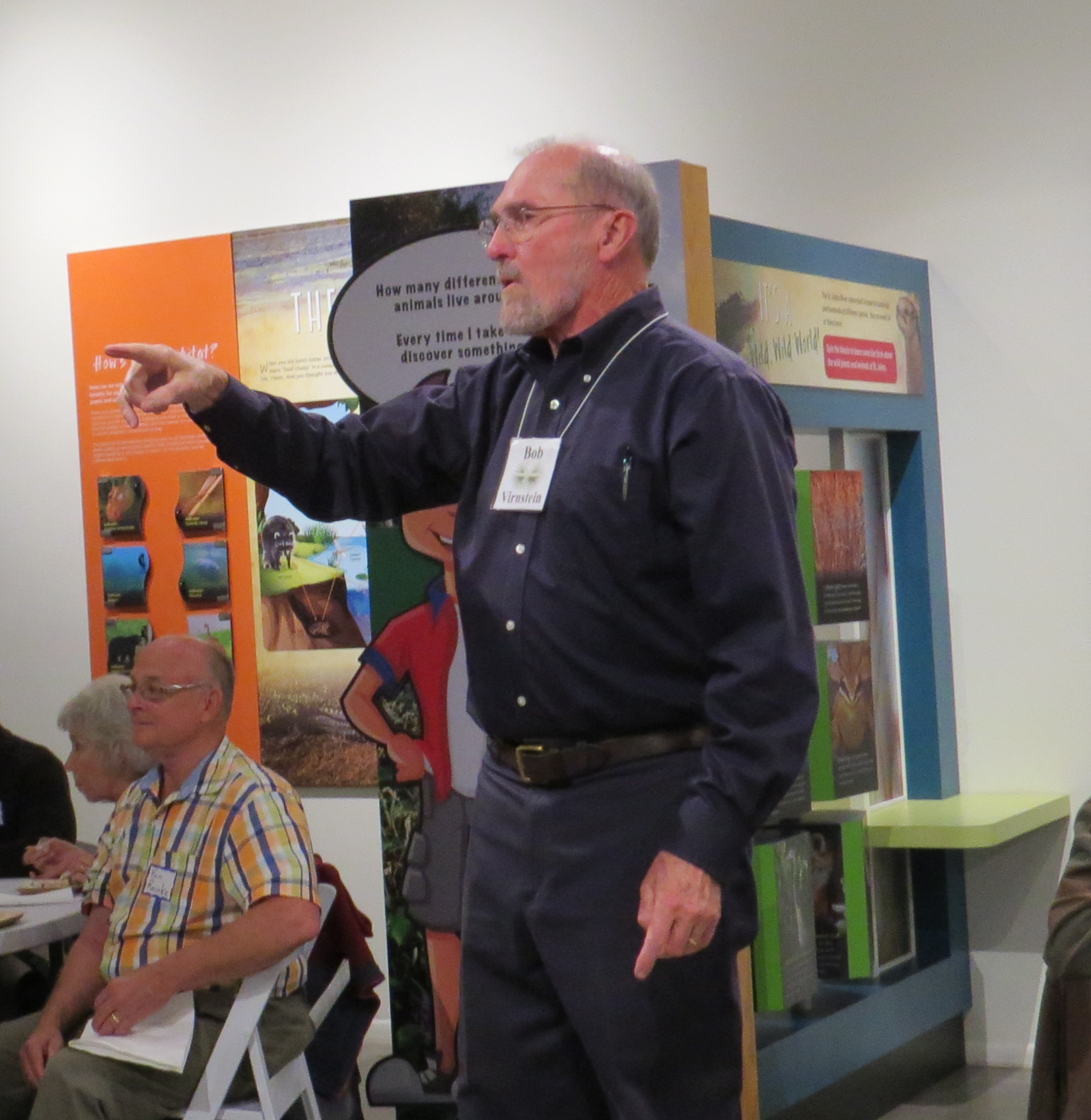
Robert Virnstein, Director, holds a PhD in Marine Science.  Bob conducted basic research on estuarine invertebrates before working at the St. Johns River Water Management District for 20 years as an environmental scientist, retiring in 2008.  During his 35-year career of ecological research on the Indian River Lagoon, Bob worked primarily on the protection and restoration of seagrass and salt marsh.  He coined the term "blueway" in co-developing a CARL proposal for acquisition of lands along the lagoon.  Bob works with various county committees developing paddling trails in Putnam County initiating the County’s 185-mile blueway.  He does environmental consulting and is active in scientific societies.

Tommy Clay Jr., Past President, is a sixth generation rancher from Grandin, in west Putnam County. The Clay family has farmed and raised cattle in Putnam County for nearly 160 years. Tommy is also past president of the Florida Cattlemen's Association and the Putnam Cattlemen's Association. He was a director for the Florida Farm Bureau and the National Cattlemen's Association. Tommy continues to farm and ranch the land with his mother, Lorene, his father, Tommy Sr., and his son, Chance.

Advisors

Karen Ahlers is president of the Putnam County Environmental Council and Ocklawaha River Restoration coordinator for Florida Defenders of the Environment. She organizes the annual Rally for the Rivers sponsored by PCEC. The weekend-long event marries eco-tourism, art, music, culture, and environmental education in an effort to promote restoration and conservation of Putnam's natural resources. In 2005, Karen was awarded Conservationist of the Year and PCEC recognized as Conservation Organization of the Year by the Florida Wildlife Federation.

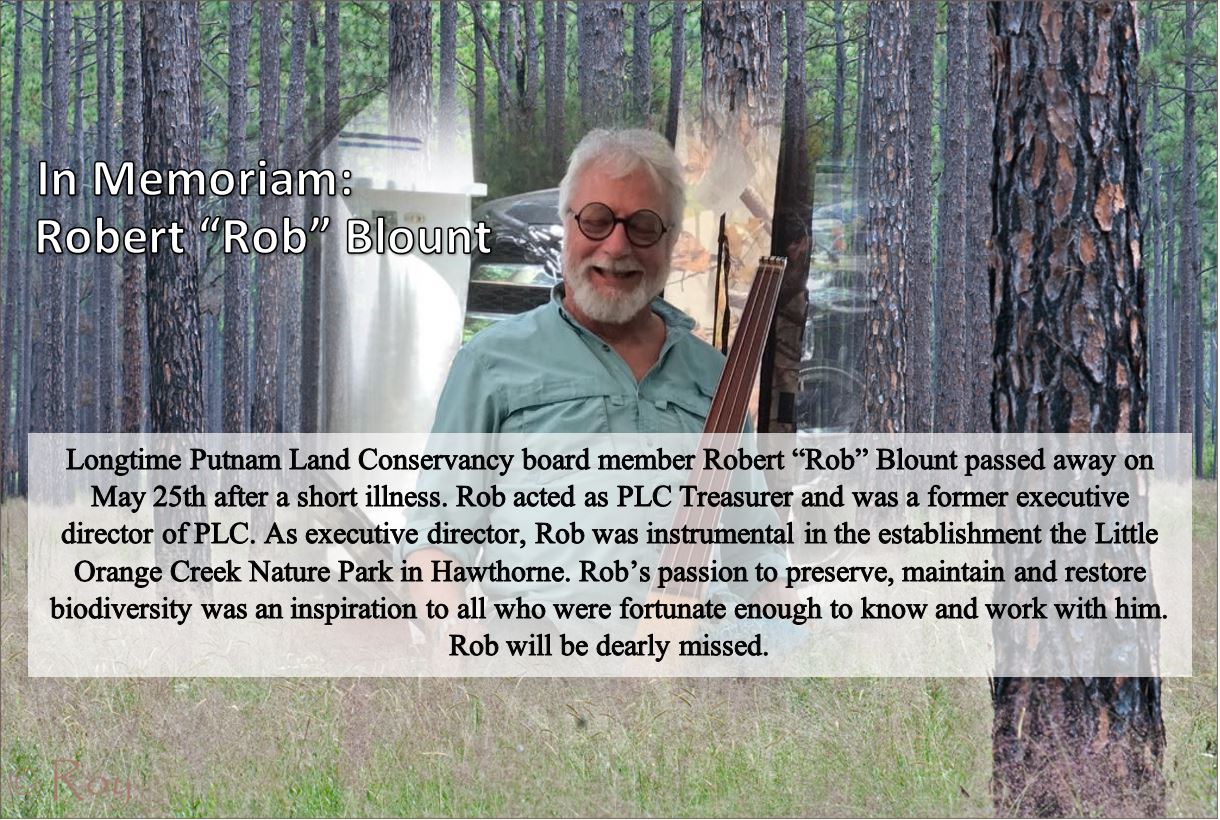
Rob Blount has over 30-years’ experience in non-profit management. Holding degrees from the University of Florida and Florida State University, Blount has worked for and with environmental organizations throughout the state to preserve, maintain, and restore biodiversity. His most recent project was the restoration of an 82-acre historic beachfront park for the City of Miami.

Nick Carter is the owner of Longleaf Land Management, a land management company that focuses on ecologically minded and alternative land management practices, such as prescribed fire and prescribed grazing. He also operates a sustainable homestead with his wife Brittney at Boll Green Acres Wildlife Sanctuary in Interlachen where they practice traditional building methods and organic gardening.

Scott Crosby is senior forester for the Florida Division of Forestry for the Etoniah Creek and Carl Duval Moore State Forests, has been the land manager for these two state forests since 1997, and has worked for the Division of Forestry since 1990. Scott has a BS degree in forest resources and conservation from the University of Florida's School of Forest Resource and Conservation and is also a member of the Society of American Foresters.

Steve Holland, PhD, is an associate professor in the Department of Tourism, Recreation, and Sport Management at the University of Florida.

Robert "Hutch" Hutchinson is the project manager at Alachua Conservation Trust, and is a former Alachua County commissioner.

Charlie Pedersen is the Waccasassa Forestry Center biologist for the Florida Division of Forestry, working out of the Gainesville office. He is involved in the Paynes Prairie Chapter of the Florida Native Plant Society. He has degrees from the University of Florida and Iowa State University.

Fiona Sunquist writes about science and biology and is the author of more than 100 major articles and five books, including Tiger Moon: Tracking the Great Cats in Nepal (2002) and Florida, an Ecotravellers' Wildlife Guide (2002).

Mel Sunquist, PhD, recently retired professor from the Department of Wildlife Ecology and Conservation at the University of Florida, and program director of the Katherine Ordway Preserve in Melrose, Florida.

In Memorium

Kathleen (Kathy) Cantwell, MD, was a founder and Project Committee Chair of the Putnam Land Conservancy until her recent passing in July 2010. Kathy retired from private medical practice in Gainesville in1996. She chaired a host of executive committees for state and local environmental action organizations, including the Florida chapter of the Sierra Club. Kathy was a member of Women for Wise Growth (PAC), board member of the Suwannee-St John Sierra Club, and advisory board member of the Putnam Land Conservancy and the Alachua County Land Conservation program. In 2000 and 2005, she received the Florida Sierra Club Panther award and in 2002 was named Alachua Conservation Trust conservationist of the year. Kathy's passion and dedication to conservation values have been an inspiration to all who had the great fortune in knowing and working with her.


Our Committees

Project Committee identifies new opportunities around the community for conservation efforts, assists in development and implementation of management plans for PLC properties. Committee also identifies sources of grant funding and performs grant writing. Work includes generating necessary documentation, maps and reference materials for submission to funding sources.

Fundraising Committee networks, promotes PLC mission through public outreach and implements planned fundraising and information events. Members work with musicians, vendors, local business sponsors, or other contacts within the community.
Finance Committee provides good fiscal direction and advice as to how best to manage the organizations limited financial resources for the long-term operation of the organization and its acquired resources.

 
Board Meeting
Monday, 1/9/12
Projects Comittee: 5:30 pm
Board Meeting: 7:00 pm
Interlachen Townhall
311 Atlantic Avenue
Interlachen, FL